
Thousands of kilometres of roads. There is only a handful of maintenance crews and no reliable automated way to find the worst damage. At AI-Matters TEF Ostrava, a Czech AI solution for road defect detection has been put through rigorous experimental testing — and the results challenge the status quo.
Consider driving a van equipped with a standard dashcam. As you drive, an AI system silently analyses the video feed, detecting potholes, drainage channels, and drain grates in real time, tagging each one with GPS coordinates, confidence scores, and a structured database entry. No manual review. No hours spent scrubbing footage.
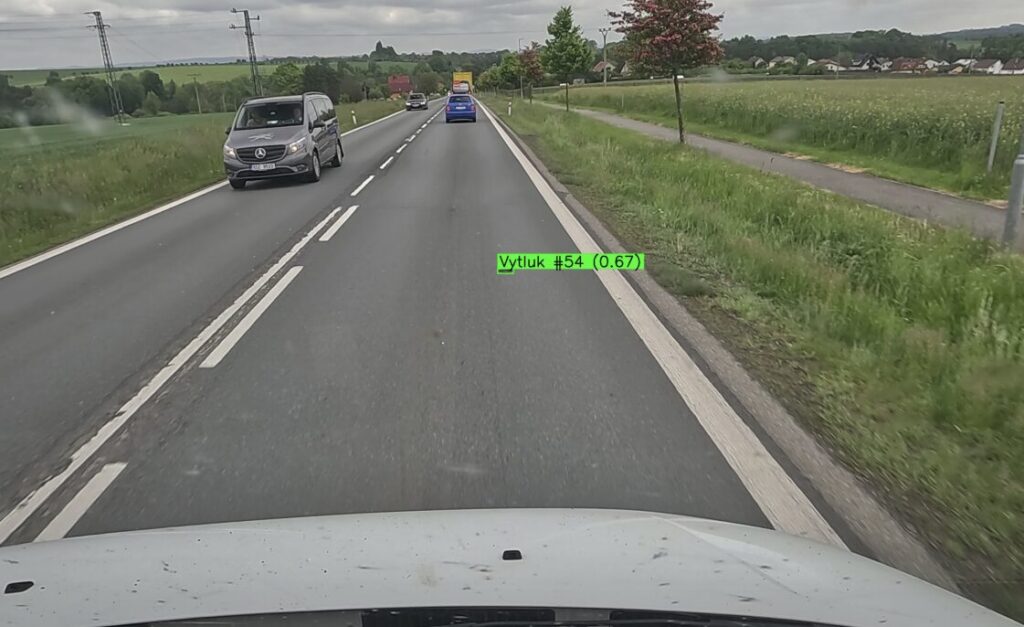
This system was developed by Signal Lab from VSB – Technical University of Ostrava and is currently being experimentally tested through the AI-MATTERS project at the Czech AI TEF node in Ostrava, in close collaboration with FUTTEC, an end-user company operating in road infrastructure maintenance.
The problem: commercial tools fall short
Road administrators across Europe face a common frustration: existing commercial AI tools for automated road surface inspection promise much but detect little. The question is not whether AI can detect road defects but whether it can do so reliably enough to replace or augment manual inspection.
To determine this, the AI-Matters Ostrava team designed a head-to-head benchmark.
The test: five methods, thousands of hours of videos
A standardized test set of 50 road scenes containing confirmed defects was used to compare the five approaches.
| Method | Defects detected | Detection rate |
| Manual inspection (human baseline) | 44 / 50 | 88 % |
| Commercial solution 1 | 8 / 50 | 16 % |
| Commercial solution 2 | 9 / 41* | 22 % |
| AI TEF candidate model 1 | 43 / 50 | 86 % |
| AI TEF candidate model 2 | 45 / 50 | 90 % |
The results were striking. The two candidate models developed and tested within AI-MATTERS not only matched human inspection; the best model exceeded it, detecting 90 % of defects compared to 88 % by trained human inspectors. Meanwhile, the two commercial solutions detected fewer than one in four samples.
These numbers confirmed our suspicion that general-purpose commercial tools are not built for the specific conditions of Central European road networks. Our models, trained on real Czech road data and leveraging advanced architectures such as RT-DETR with hybrid assignment training, are purpose-built for this task, says Dominik Vilímek at VSB Technical University of Ostrava.
Beyond detection: measuring the damage
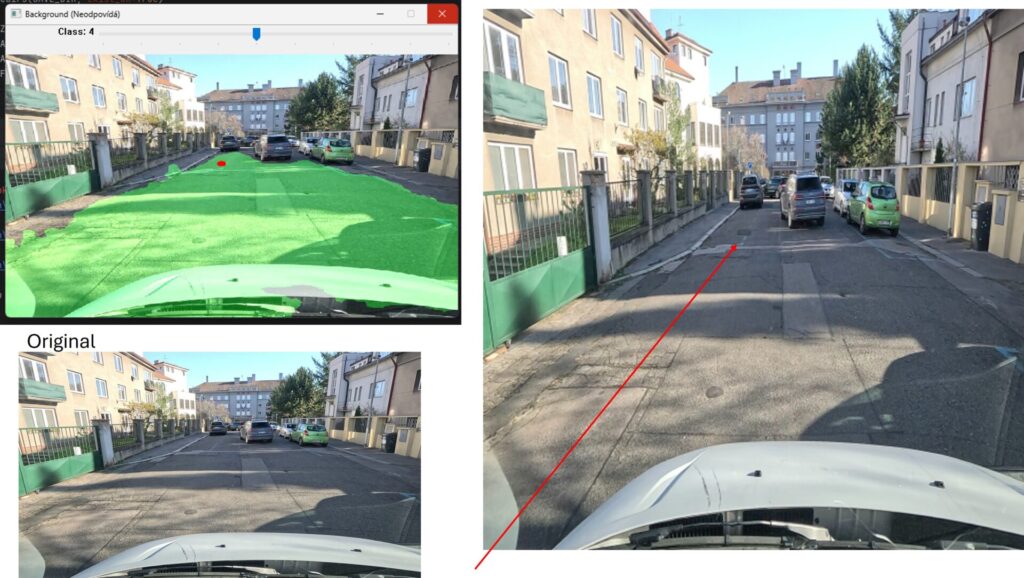
Detecting potholes is only the first step. The real value for road administrators lies in knowing how big it is, how fast it is growing, and when to schedule repairs.
Therefore, the second phase of testing within AI-MATTERS focuses on defect parameterization, which automatically computes geometric characteristics such as length, width, and area from the model’s output. The team is also experimenting with diffusion-based generative AI models to create richer defect representations, handle noisy or incomplete data, and support downstream tasks, such as predictive maintenance planning.
We are moving from “there’s a pothole” to “here’s a 38×22 cm defect that has grown 15 % since the last survey” — that is the information a maintenance planner actually needs, adds Vašek Mlynářík from FUTTEC company.
Testing across hardware profiles
Industrial deployment means running on whatever hardware is available, from a GPU-equipped cloud server to a CPU-only edge unit mounted in a service vehicle. The AI-MATTERS Ostrava testing program systematically benchmarks each model across multiple hardware configurations, measuring latency, throughput, and resource utilization. Goal: Clear deployment recommendations matched real-world constraints.
A third testing phase validates the full integration stack (Docker containerization, API performance, load testing, and basic security controls), ensuring that the solution is not only accurate but also production-ready.
What this means for European industry
The AI-MATTERS testing infrastructure enabled something that most SMEs cannot do alone: rigorous, standardized, and hardware-diverse benchmarking of AI models against both commercial alternatives and human baselines. The results were documented in validation test reports aligned with AI TEF Manufacturing standards, making them reusable and transferable across different road networks and operational environments.
For FUTTEC and similar companies, this means access to AI that actually works — tested, validated, and ready for deployment.