
The article originally prepared and published by Komora Plus is available here.
Do you also find it impossible to start your morning without a cup of coffee? We can brew it calmly at home, enjoy it at work, head out to a café, or grab one from a vending machine. It all depends on our options and preferences. We take it for granted that we’ll be able to get our morning drink anywhere. Yet we rarely realize how complex the logistics behind it are especially when it comes to vending machines. So complex, in fact, that the company Dallmayr Czech Republic decided to tackle it together with experts from the Czech Institute of Informatics, Robotics and Cybernetics (CIIRC CTU).
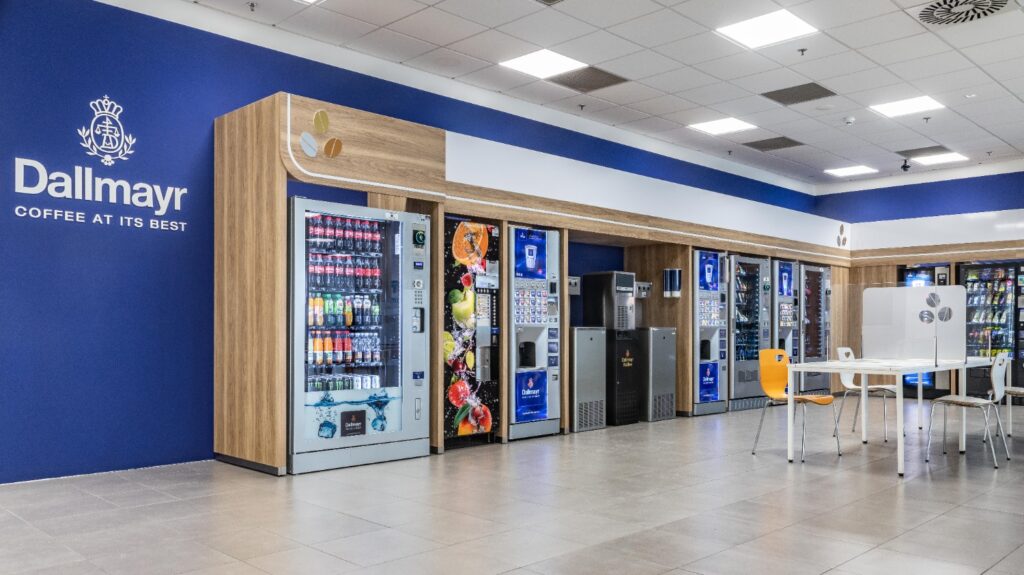
At the very beginning stands the simple wish to have a vending machine or coffee maker at all. The customer contacts the supplier, who fulfils this request. This marks point zero, from which everything else unfolds. It is the start of a continuous cycle of stocking and maintenance. „Maintenance is a standard matter. We work with predictions, manufacturer recommended service intervals, and our own experience. Thanks to that, we know how to ensure prevention, regular inspections, cleaning, sanitizing, and descaling. But the biggest challenge is the logistics and resupplying of the machines specifically, replenishing food items,“ explains René Sion, Managing Director of Dallmayr Czech Republic.
It’s not just about coffee machines, which are usually refilled with powdered mixes with relatively long shelf life. According to Sion, logistics is much more demanding for baguette machines and other rapidly perishable foods: „These products fall under the HACCP protocol, which requires maintaining specific temperatures from the supply warehouse all the way to the machine with its set operating temperature, which typically stays below five degrees Celsius.“
Every new vending machine becomes part of a vast network. „Across the world mainly in Europe, the Emirates, and South Africa we operate roughly one hundred and fifty thousand machines. In the Czech Republic, where we have been present since 2001, we currently have around sixteen thousand devices registered on the market. Some are leased, some sold, and several thousand are part of our own network,“ lists the Managing Director of Dallmayr Czech Republic.
None of these thousands of machines can be allowed to run empty. Supplying central or regional warehouses so-called cross-docks is not the main problem. The challenge lies in the last mile, or more precisely, the last few meters: the journey from the mobile warehouse to the machine itself. Efficient replenishment depends on a well-planned route and correctly prepared goods.
Sometimes the process still works like this: the operator arrives at the machine, checks what is missing, and only then searches for the needed items in the vehicle. This takes time, and keeping the refrigerated truck door open consumes a significant amount of energy. This is exactly where there is room for improvement.
Fortune-telling without a crystal ball
That is why Dallmayr has launched a joint project with the Czech Technical University in Prague. Artificial intelligence is expected to help optimize and redesign the logistics processes.
„We are very pleased to be able to collaborate with Dallmayr. Both institutions are roughly the same age around three centuries. I am glad that we have come together on the topic of digitalization and AI. Artificial intelligence can influence logistics on multiple levels. One dimension is optimization, meaning the search for optimal scenarios both in standard situations and in unpredictable ones for example, when an operator, technician, or team suddenly becomes unavailable and the entire model needs to be recalculated quickly, ideally with minimal human effort. The advantage of artificial intelligence is that it enables us to explore scenarios across the full scope of the model, which would be difficult to achieve by other means.“
explains Ondřej Beránek, the head of the Czech center of the European association AI Matters, which operates under the umbrella of the Czech Technical University in Prague (CTU).
The second area in which artificial intelligence can assert itself, according to Ondřej Beránek, lies in its ability to predict. AI will not only know when a particular machine needs technical maintenance, but more importantly, it will determine when and with what products its supplies need to be replenished. Put simply, the system will estimate when and where sandwiches will sell out, where snacks will run out, and where coffee will be depleted. The supply operator will therefore no longer have to check on-site which items are missing, but will instead take the pre-prepared goods straight to the machine. This significantly speeds up the entire process and also saves energy, as the cooling compartment will only need to be opened for a few seconds. And of course, it also saves fuel, because the system plans the route so that operators stop only at the machines that actually require service.
At first glance, such prediction may resemble gazing into a crystal ball; however, as Karel Košnar from the Czech Institute of Informatics, Robotics and Cybernetics at CTU explains, everything is based on hard data: „Artificial intelligence works with a very long time series in which it identifies patterns and recurring cycles. By analyzing historical data, it is able to predict with a certain degree of accuracy how sales will behave in the future.”
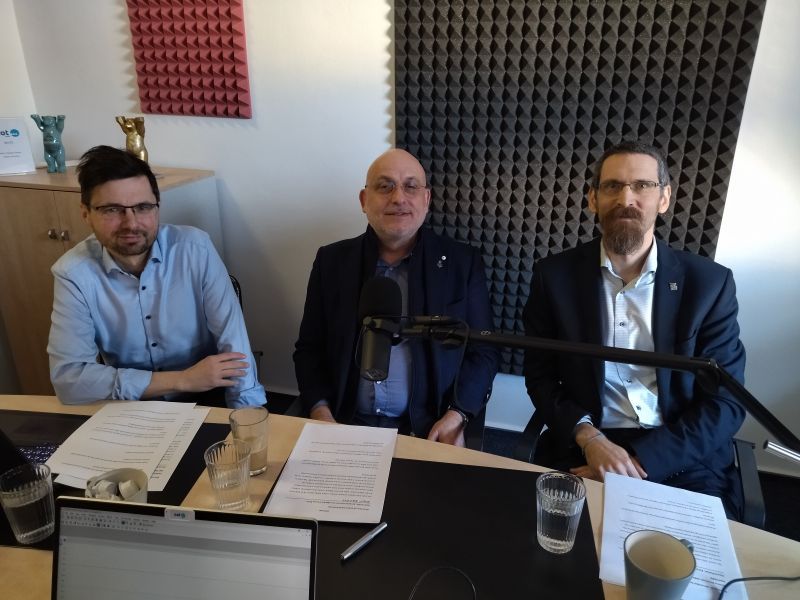
Listen to the podcast by COT Group to learn even more about how our AI experts are transforming the world of vending machines and logistics.
Not all vending machines are the same
A crucial factor for successful vending machine sales is that the machine must never look empty. If customers completely buy out a particular item, it can discourage others. „When you see that two or three products are missing entirely, you might think it was something excellent something in high demand that you missed out on. And because you don’t want to buy anything ‘second-rate,’ you’d rather walk away than choose from what’s left. Even though you probably would have bought the remaining items anyway. But when every slot has at least something in it, you choose based on what you actually want. This means we need the machine to empty gradually so that no compartment is ever completely empty. The goods therefore must be replenished before they are fully sold out,” explains René Sion, describing this interesting methodology.
At the same time, it is necessary to consider where each vending machine is located. „A machine in a factory behaves differently than one in an office or at a gas station… The location of the machine defines the consumer, and people behave differently in each environment,” notes Ondřej Beránek. René Sion adds that time also plays a role: „A worker on the production line will most often appreciate an instant coffee. But at lunch in the cafeteria, or after work before heading home, the same person wants to choose from a wider range of products. It’s the same individual, but for us it represents several different customer types. We have to reflect all of that in our offering.”
This affects not only predictions for restocking goods, but even the placement of the buttons on the machines so that the button for the most in-demand product is as accessible as possible and customers don’t have to search for it.
We Chat Quite Naturally with Artificial Intelligence
Because CTU experts have been working on implementing artificial intelligence in logistics for quite some time and the systems are already in an advanced stage we could see the first results of the collaboration between Dallmayr and CTU within half a year. But it doesn’t have to stop at logistics. Fairly soon, within a few years, we may encounter artificial intelligence on customer service lines. These won’t be voice menus, but full-fledged conversations in which we unless the system explicitly tells us won’t even realize we’re speaking to a robot.
Regular customers will even be able to set the robot’s voice color according to what they find most pleasant. Such a system will enable customer care twenty-four hours a day, seven days a week. It will recognize returning customers by their stored phone number and immediately see their purchase history, which it can easily repeat. The system will fill out an order instantly something that would naturally take human operators longer.
And for anyone who insists on “warm human contact,” that option certainly won’t disappear. After all, not everything can be solved by a robot, and we will still need human workers in the future.