
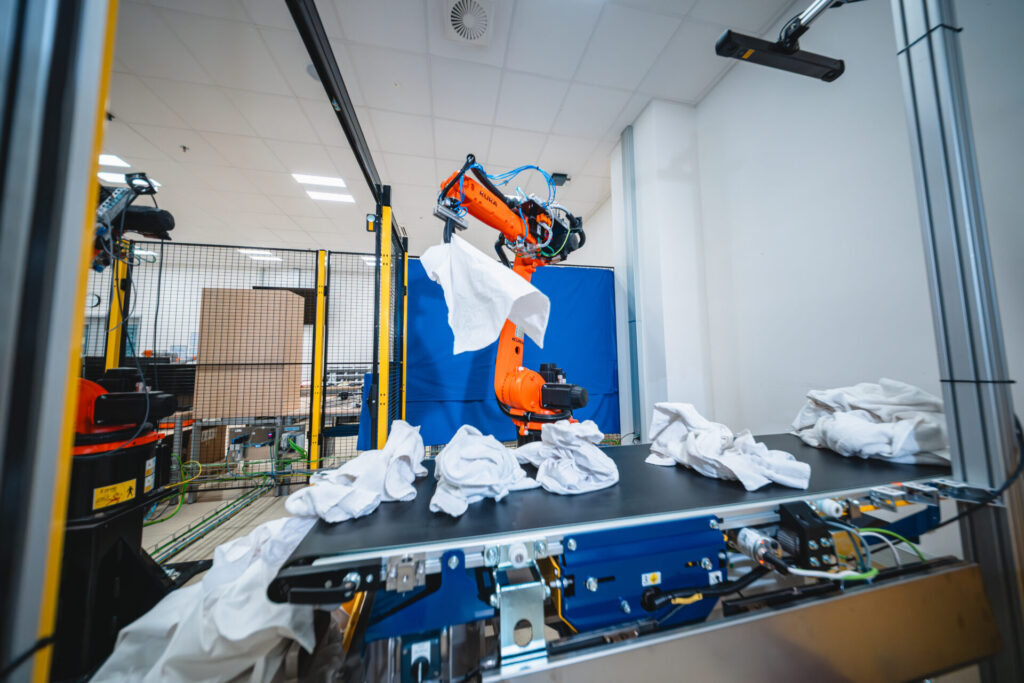
Every day, Laundry Kyselý processes large amounts of laundry for hotels, restaurants, and other businesses. Before the washing begins, the incoming laundry needs to be sorted and placed into the appropriate containers. At the moment, this is largely a manual job. For a person, sorting a pile of laundry is something that can be handled almost instinctively. An operator can recognise different items, adjust their grip depending on the material and shape, and react immediately if several pieces arrive together or become tangled. A robot does not have that flexibility automatically. It needs to see the individual pieces, understand what it is looking at and decide how to pick each item up. And it needs to do this repeatedly, quickly and reliably. That is the challenge Laundry Kyselý wanted to explore.
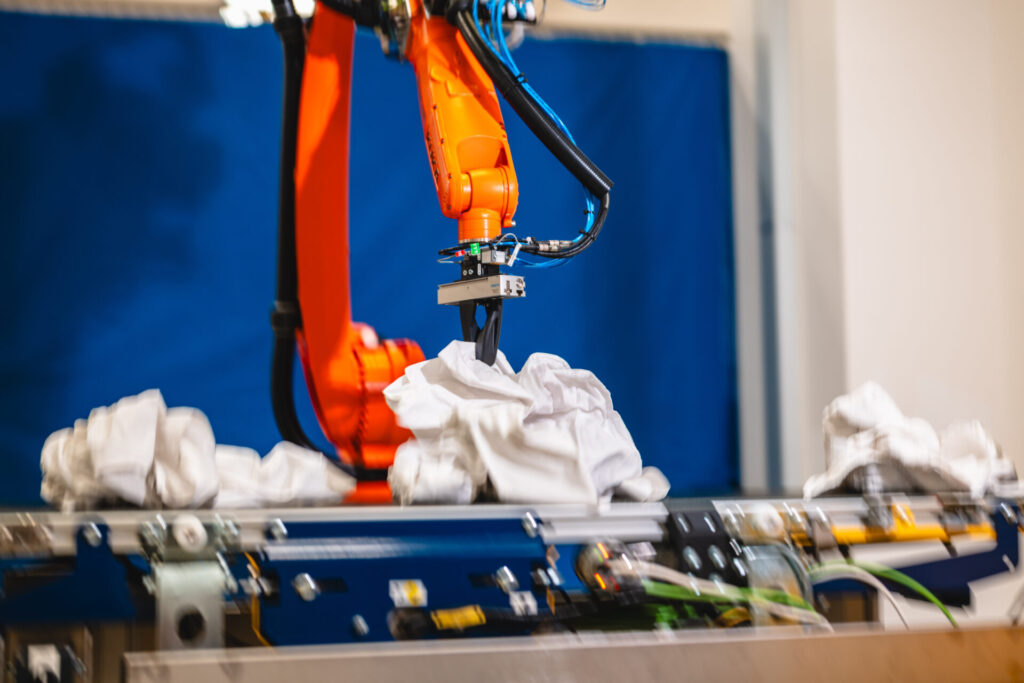
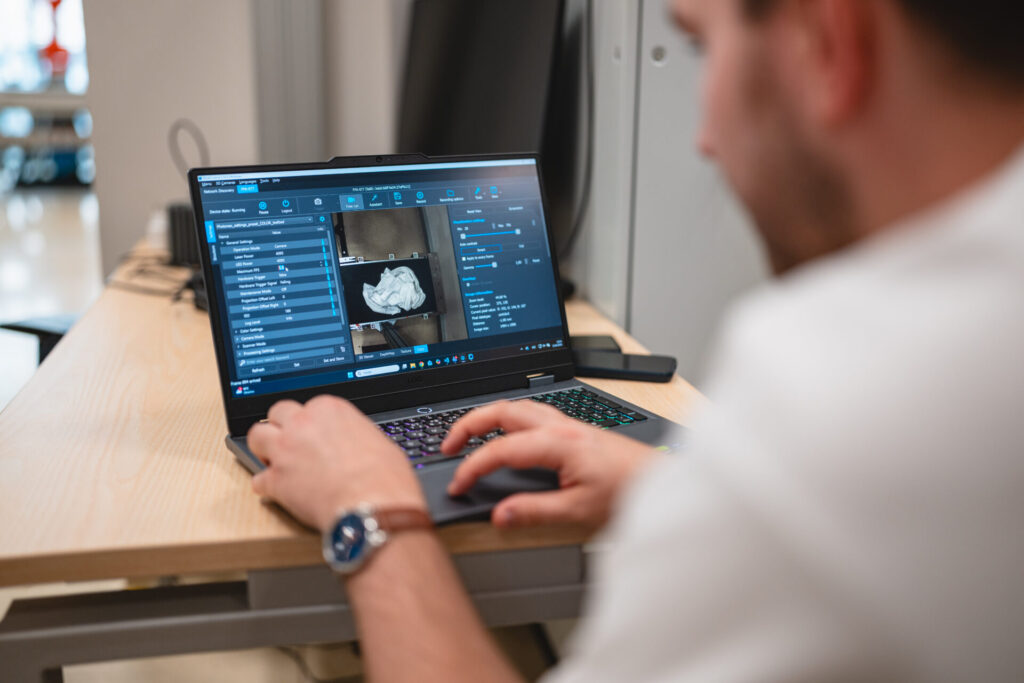
Together with CIIRC CTU and TEF AI-MATTERS, Laundry Kyselý is developing a proof-of-concept for robotic laundry sorting. The experimental setup combines a conveyor belt, camera-based vision, image processing and a robotic arm. As laundry moves along the conveyor, the camera captures the items and provides information about their position and shape. The robotic system can then use this information to identify individual pieces, grasp them, and place them in the appropriate location.
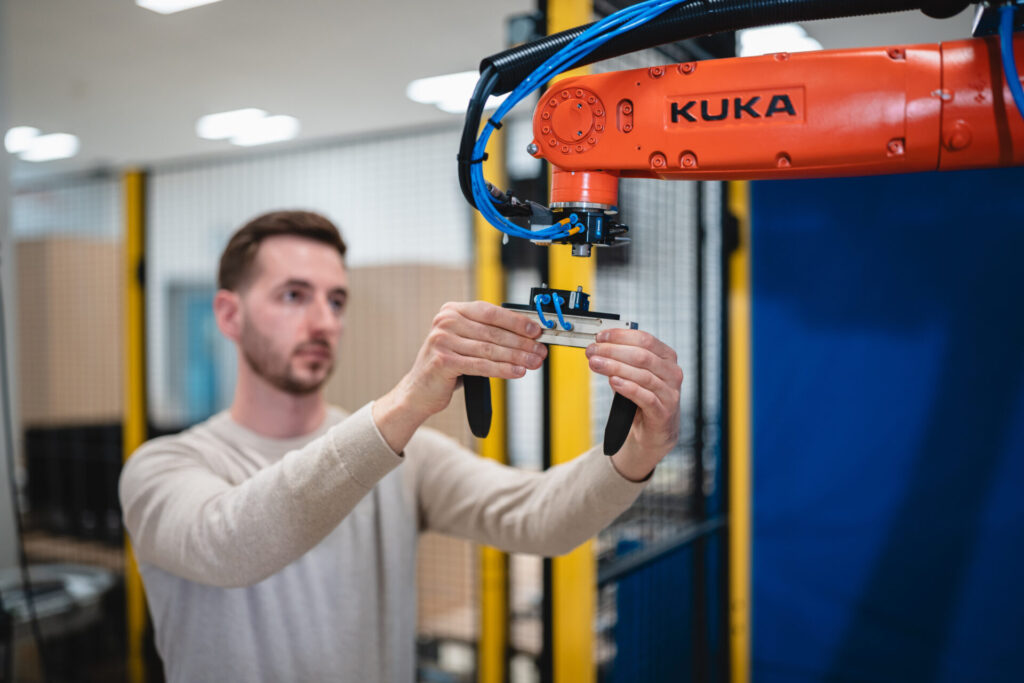
But making the robot perform the task once is not enough. The team is testing different types of robotic grippers and looking at how quickly and reliably the system can handle different laundry items. They are also evaluating the overall robustness of the solution, which is an important consideration in an industrial environment where the system would need to operate continuously. The challenge is made even more important by where sorting sits in the overall process. It is the first stage of the laundry workflow, so its performance can influence everything that comes after it. A solution that works but is too slow or unreliable would not be enough.
Testing before making the leap to automation
This is where experimentation becomes particularly valuable. Rather than moving directly from an idea to a full-scale installation, Laundry Kyselý can use the AI-MATTERS environment to explore how the technology performs, identify its limitations, and understand what would be required for real deployment. The proof-of-concept brings together expertise in robotics, AI and process optimisation, allowing the team to test the technology around a very concrete industrial problem.
The outcome will not simply be a working demonstration. The project will also provide operational data, including information about cycle times and system robustness, as well as recommendations for suitable grippers and possible improvements. The next question is therefore no longer simply “Can a robot sort laundry?” It is “What would it take to make robotic sorting work reliably at industrial scale?” And that is the question the project is now helping Laundry Kyselý answer.
From a manual task to a new way of working
For Laundry Kyselý, the project is a first step towards understanding whether robotic sorting could become part of its future operations. For TEF AI-MATTERS, it is a good example of what technology experimentation can achieve when research expertise meets a real industrial challenge: instead of testing robotics in isolation, the technology is being pushed to deal with the unpredictability of an actual production process. The project is still a step away from full deployment. But that is precisely the point. Before investing in automation, Laundry Kyselý is testing what works, learning where the challenges lie and building the evidence needed to decide what comes next.
Technical specification of the solution
The team developed an image-processing algorithm that uses 3D camera to identify suitable grasp positions and orientations of laundry items. It allows individual pieces to be picked directly from a moving conveyor while the robot’s motion is synchronized with the belt. The gripper fingers must hold the single piece of laundry securely during lifting and transfer, then release it reliably. Different finger shapes and contact surfaces were designed and tested, utilizing our 3D printing center for rapid prototyping. The complete separation cycle was tested in a physical industrial robotic cell using several types of laundry. The project delivered a tested proof of concept and an algorithm for generating grasp poses from camera images. Testing the system as a whole identified bottlenecks in the process and highlighted the changes needed to shorten the cycle time and make separation faster.